
What Starcloud Does, and Why It Matters Now
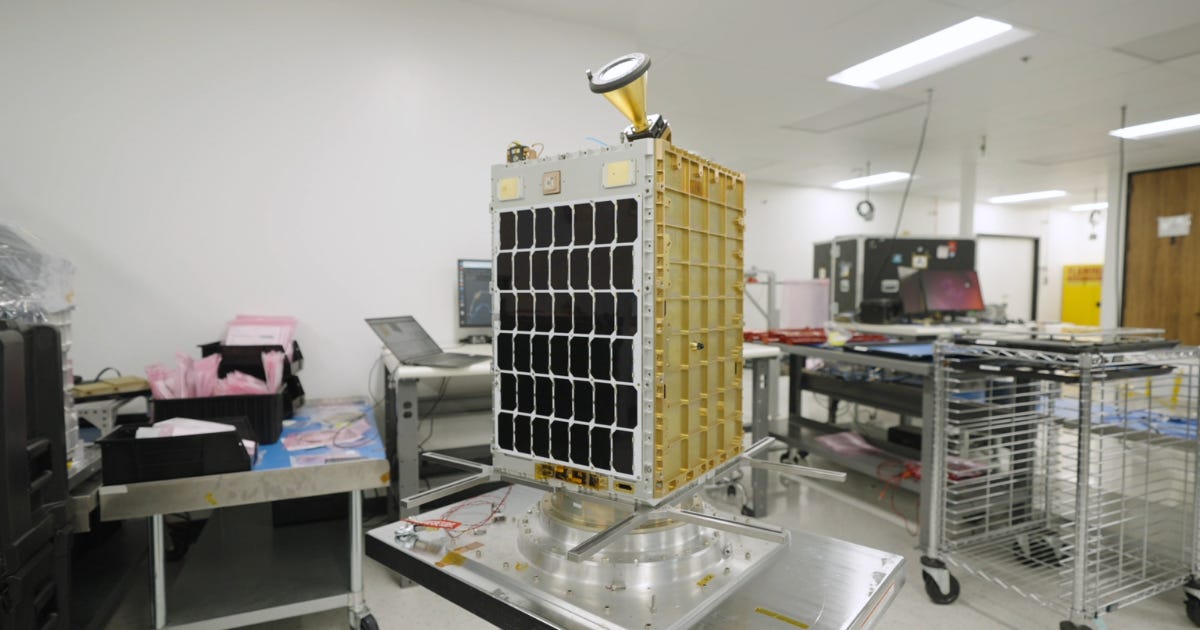
In November 2025, a 130-pound satellite called Starcloud-1 ran an Nvidia H100 in LEO and trained a model on it. It was the first time a terrestrial-class AI chip had done real work in space.1
17 months after Y Combinator demo day, the company behind it was valued at $1.1B, the fastest any YC company had reached unicorn status and a Series A more than double the next largest in the program's history. By August 2026, NVIDIA joined at roughly $25 and the valuation reached $2.3B.2
What Starcloud is building is an AI data center in orbit, a constellation of satellites that generates its own solar power, rejects waste heat into space, and sells GPU compute as a cloud service with no grid connection, no land, and no cooling bill.
The ambition is enormous, and the economics do not work today. Compute in orbit costs 3 to 4x what it does on the ground, and the whole bet turns on one variable, the cost of putting mass into space, falling far enough to close the gap.
This is a teardown of what has to be true for that bet to work, and what happens if it doesn’t. It starts with the problem that makes anyone consider orbit in the first place.
The Problem
Every forecast for artificial intelligence takes for granted that the compute to run it will exist, and the real question is whether the physical inputs can keep pace.
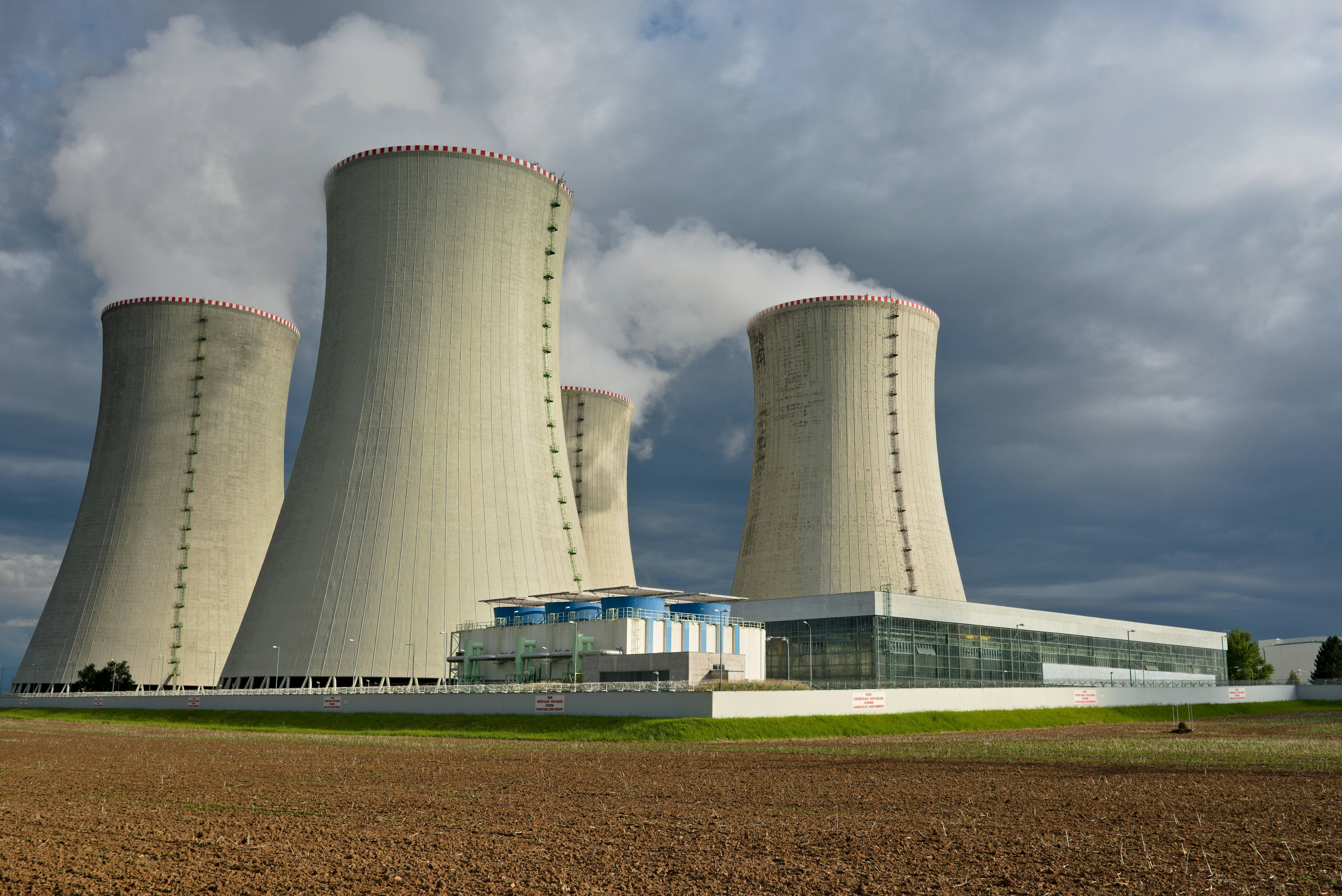
A frontier AI model is not built in software alone. It is built in buildings full of specialised chips, and those buildings need three things in quantities the world has never had to supply at once, electricity to run the chips, a way to carry off the heat they produce, and the physical space and time to assemble all of it.
Each is now a bottleneck worth taking on its own, and they share one root, every one is a limit of building on Earth.
Power
The first wall is electricity, and it is the one the industry names most often because it is the easiest to count.
The International Energy Agency projects data center electricity demand worldwide more than doubles by 2030 to around 945 TWh, growing about 15% a year, over 4x faster than every other sector.3
That is up from 415 TWh in 2024, about 1.5% of the world's electricity.4 The number underneath matters more. Worldwide, the AI-optimized servers doing the training and inference are growing near 30% a year, 3x the rate of conventional ones.
In the United States the curve is steeper. Data centers drew about 4.4% of the country's electricity in 2023 and are projected to reach 6.7 to 12% by 2028.5
In absolute terms the load climbed from 58 TWh in 2014 to 176 TWh in 2023, and is set to reach 325 to 580 TWh by 2028, having already more than doubled between 2017 and 2023 as AI servers filled the racks.6
A conventional data center draws 10 to 25 megawatts. A single hyperscale AI facility can draw 100 or more, as much in a year as 100,000 households. One building, one connection point, the load of a small city.7
The market has already repriced power. In the largest US grid region, the auction that pays generators to stay available for peak demand tells the story in four numbers.
It cleared near $29 per MW-day for 2024-25, then jumped almost 9x to about $270 for 2025-26, and hit the regulated cap at $330 and $333 in the two years after.8910
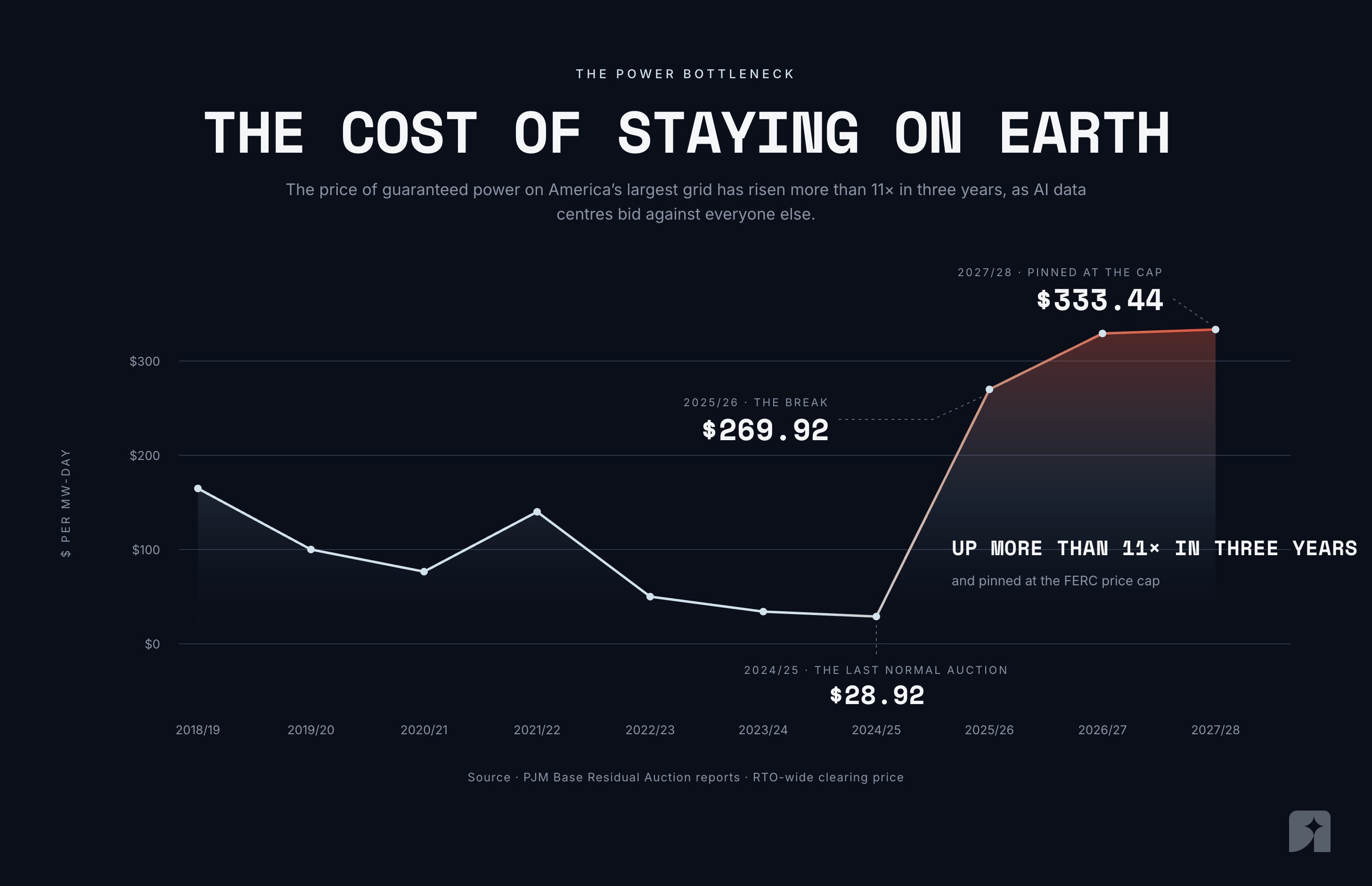
Roughly 63% of that first surge traced to data centers, about $9.3B in a single auction, by the grid operator's own market monitor.11
Finding the power turns out to be only half of it, because nearly everything that consumes it comes back as heat.
Heat
A data center is, at bottom, a machine for turning electricity into heat, and the newest machines pack far more heat into far less space.
On average a rack, the cabinet holding the chips, draws 7.6 kW; Nvidia's AI generations leave that far behind.12
A rack of A100s ran near 25 kW in 2022, the H100 about 40 kW in 2023, the GH200 around 72 kW in 2024, and the GB200 roughly 132 kW in 2025, with 2026 designs projected near 240 kW. In four years, the heat in one cabinet rose nearly 10x.13
A well-designed air-cooled rack handles 30 to 40 kW at best. The H100 sat at that edge; the GB200, at 132 kW,1415 ships with direct-to-chip liquid cooling built in.16 Going air to liquid re-plumbs the building, now mandatory for the densest hardware.
Carrying that heat away, by evaporation in cooling towers or by liquid loops, draws water. US data centers consumed about 17.4 billion gallons directly in 2023, projected to reach 38 to 73 billion by 2028.17
The power plants supplying their electricity consumed roughly 211 billion gallons that year, about 10x the direct draw.18 Followed far enough, a heat problem becomes a water problem, and water is local, contested, and slow to permit.
Power and cooling can both be bought with enough money and enough water. The one input no amount of capital buys quickly is time.
Time
Even where the power and the cooling already exist, the constraint that remains is how fast any of it can be built.
At the end of 2024, roughly 2,290 GW sat waiting in US interconnection queues, nearly 2x the entire existing power fleet.1920 Clearing that queue now takes a median of about five years, up from under two a decade earlier, and only 19% of projects entering between 2000 and 2018 were ever built.21
Building new generation is no faster. New combined-cycle gas turbines carry lead times of five to seven years, and GE Vernova alone closed 2025 with an 83 GW order backlog stretching into 2029.22 Turbine prices are up about 195% since 2019. An order placed today does not arrive before the end of the decade.23
Demand moves at the speed of software. Supply moves at the speed of transmission lines and turbine factories, and the gap between the two is measured in years.
The result is an industry with more demand than it can physically place, held back not by ambition or capital but by the grid, the water, and the calendar.
Every constraint in this section is terrestrial. The proposed fix starts from the premise that not all of them have to be.
How It Works
The problem is power, heat, and time. The proposed fix is a machine that makes its own power, rejects its own heat, and scales by launch rather than by land.
Energy
In orbit, the sun delivers about 1,361 watts per square meter with no atmosphere, no weather, and no night.24 A satellite in a dawn-dusk sun-synchronous orbit rides the boundary between day and night in near-permanent sunlight,25 producing 5 to 9x the power density of ground-based solar.2627
The power is generated on the panel and consumed by the chip inches away. No grid interconnection, no five-year queue, no turbine order stretching to 2029.
Power is the part orbit makes easy. All of it becomes heat, and in space heat has only one way out.
Thermal
There is no air in space, so convection is impossible. Heat rejection is entirely radiative. The satellite faces its radiators toward deep space and radiates waste heat at a sink temperature near absolute zero.
No chillers, no evaporation towers, no water. But the engineering is not free.
Every square meter of solar panel generating power demands roughly another square meter of radiator to reject the heat, making the thermal system a structural equal of the power system.
Keeping panels pointed at the sun, radiators at the void, and antennas at Earth simultaneously requires complex attitude control.2829
The thermal problem is real. It is also a different kind of problem from the one on the ground, an engineering problem rather than a resource problem, and it does not draw 17 billion gallons of water a year.
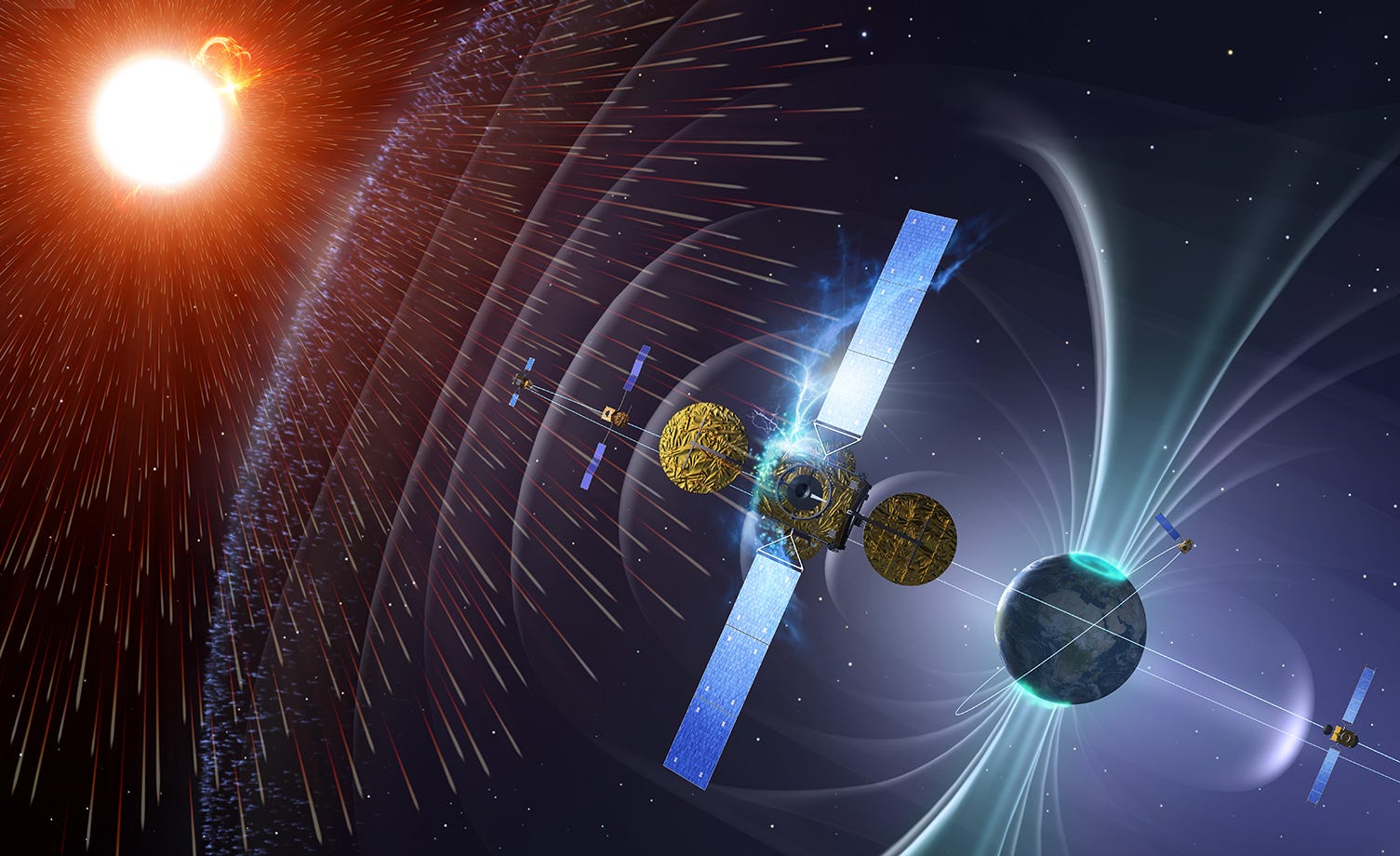
Power and heat are solved one satellite at a time. Growth is a matter of how many you fly, capacity scaling by launching more, not by acquiring land, pulling permits, or waiting for grid interconnection.
The constraint is launch slots and manufacturing throughput, and one satellite has already cleared both.
What Has Flown
Starcloud-1 is the proof that this is not a whitepaper.
A 60 kg satellite on Astro Digital's Corvus-Micro bus, launched November 2, 2025 into a 325 km orbit on a SpaceX rideshare.
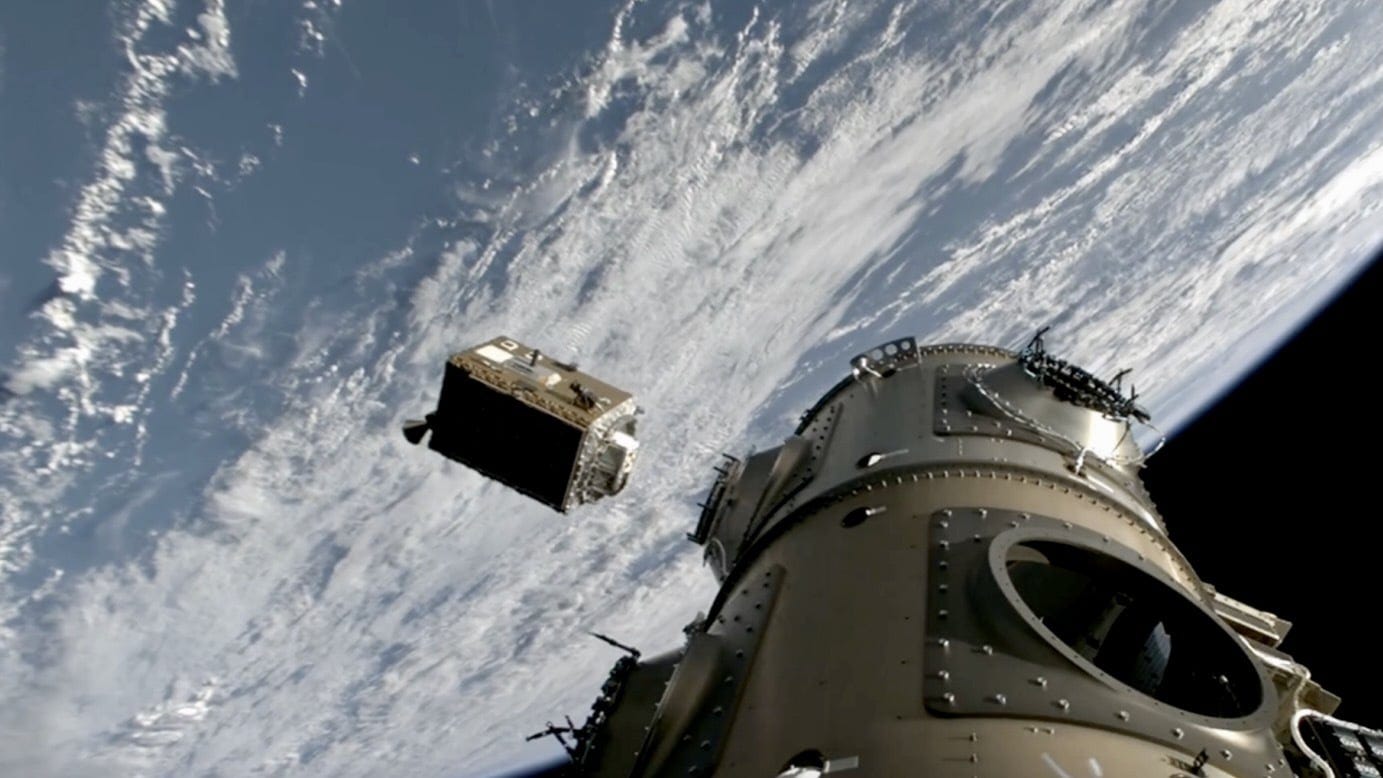
It carried the first Nvidia H100 in space, 100x more GPU compute than any prior space-based system, ran inference on Google's Gemma, and trained NanoGPT on Shakespeare, the first LLM training in orbit. Built in 21 months on $3M.3031323334
What it did not show matters too. It did not train a frontier model, build a multi-GPU cluster, demonstrate years of reliability, or prove that orbital compute is cheaper.35
It was one satellite doing a deliberately manageable job. The interesting fact was not the workload. It was that training crossed the atmosphere and worked.
What Comes Next
Starcloud-2 is a pair of 8 kW satellites launching on rideshare in 2027, carrying multiple H100s and Nvidia’s Blackwell B200, with 100x the power generation of Starcloud-1. These will run orbital inference for US government customers.36
Starcloud-3 is the constellation-scale vehicle, a roughly 2-ton, 100 kW spacecraft designed for Starship’s deployment bay. This is what the 88,000-satellite FCC filing describes, and it is the vehicle the economics depend on.3738
What Orbit Cannot Do
Latency from LEO is roughly 3 to 8 milliseconds one-way, comparable to long-haul fiber. But the full round-trip with uplink, processing, and downlink adds real overhead.39
Real-time workloads like trading, gaming, and video are poor candidates for orbit.
The natural fit is work that tolerates latency and demands compute. Batch inference, training runs, scientific simulation, and processing data that already lives in space.4041
Inter-satellite bandwidth is a further constraint. Training synchronises gradients across thousands of GPUs at every step and demands sustained throughput that current optical links cannot match.
The harder question is who builds this, and why they got there first.
Origin and Team
A company this early is a bet on the people before it is a bet on the physics.
The Founding Insight
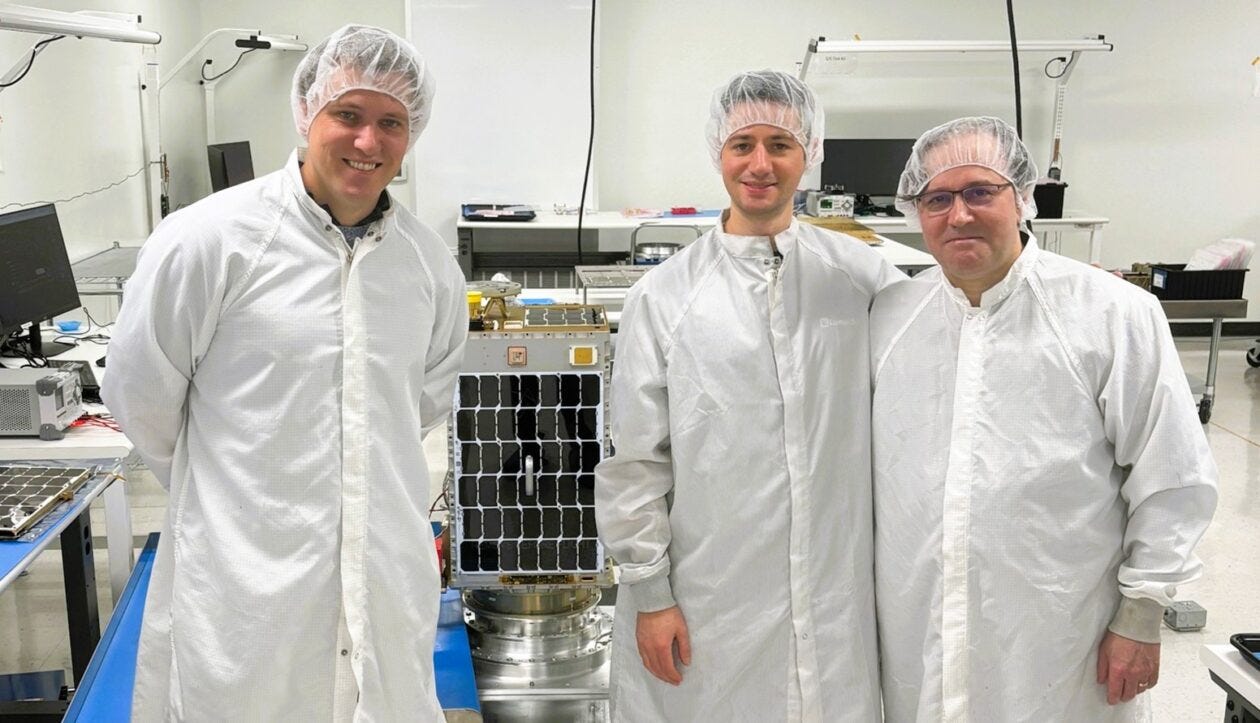
Starcloud was founded in January 2024 as Lumen Orbit by three co-founders who saw the same opening from different angles.4243
Philip Johnston identified the opportunity while at McKinsey working on satellite projects for government space agencies.44 Launch costs had fallen far enough that orbital infrastructure was no longer a physics experiment.
The question he brought was whether the data center itself could move to space. To build the answer he partnered with Ezra Feilden and Adi Oltean, two engineers whose backgrounds map directly onto the hardest parts of the problem.
The company relocated from El Segundo to Redmond, Washington within a month of founding to sit near the space and data center talent at Starlink, Amazon Leo, AWS, and Azure. It graduated from Y Combinator’s Summer 2024 batch, and over 200 VCs competed to get into the $11M seed round.45
The Founders
Philip Johnston is the CEO and a second-time founder, having co-founded Opontia. At McKinsey he ran satellite projects for national space agencies.
His training spans applied mathematics and theoretical physics at Columbia and a Wharton MBA. He also holds a Harvard MPA in national security and technology and is a CFA charterholder.
Also co-founded the Fermi Explorer, a non-profit planning to send the first spacecraft to Alpha Centauri.46
Ezra Feilden, CTO. A decade in satellite design, specializing in deployable solar arrays and large deployable structures, the exact engineering that decides whether Starcloud-3 and the constellation beyond it can be built at scale.47
Previously at Airbus Defence and Space and Oxford Space Systems, working on missions including NASA’s Lunar Pathfinder. PhD in Materials Engineering from Imperial College London.
Adi Oltean, Chief Engineer. Previously a Principal Software Engineer at SpaceX on the Starlink network team, enabling Starlink for in-motion users including Starship. Before that, Microsoft Azure.
His background gives the team inside knowledge of the launch and constellation infrastructure they depend on.
The Speed
Founded January 2024. In orbit November 2025. Unicorn March 2026. 21 months from founding to orbit, 17 from demo day to a $1B valuation, on a team of 12.
The timeline is the founders’ strongest credential. It does not prove the economics work. It proves these people execute fast enough to find out whether they do.
Speed earned a valuation. Whether the market underneath it is real, and whether the window is open now rather than five years ago, is the next question.
Market and Timing
The size of this market depends entirely on which number you believe, and most of the numbers in circulation are the wrong ones.
Size
Start with the figure everyone quotes, then take almost all of it away.
The space economy is projected to reach $1.8T by 2035, up from $630B in 2023, roughly the size of the semiconductor industry.4849
But it is the wrong number for this company. Most of it is space-enabled services on Earth, communications, navigation, and Earth observation, not compute in orbit. Starcloud is a sliver of a sliver of it.50
The market that counts is on Earth. AI data centers are projected to need $5.2T in capital by 2030, part of $6.7T across all data centers.51
That is the pool orbital compute is reaching for, the honest ceiling, and the dream rather than the near-term.
What is addressable this decade is far smaller and mostly space-native. Processing data that originates in orbit, plus defense demand, maps to an Earth observation market near $5B today52 and a broader geospatial analytics market near $11B, heading toward $7B and $18B by 2030.53
The distance between a $5T dream and a $10B reality is the whole question, and it turns on cost, not ambition.
Why Now
The reason this is a 2026 conversation and not a 2021 one comes down to a single variable that finally moved.
Launch cost has fallen more than 90% in two decades, from roughly $54,000 per kg on the Space Shuttle to about $3,000 per kg on a reused Falcon 9.54
A peer-reviewed 2026 study puts the long arc at $87,023 per kg in 1960 down to $3,868 in 2025, cost falling about 21% for every doubling of mass launched.55 Starship targets roughly $200 per kg.56
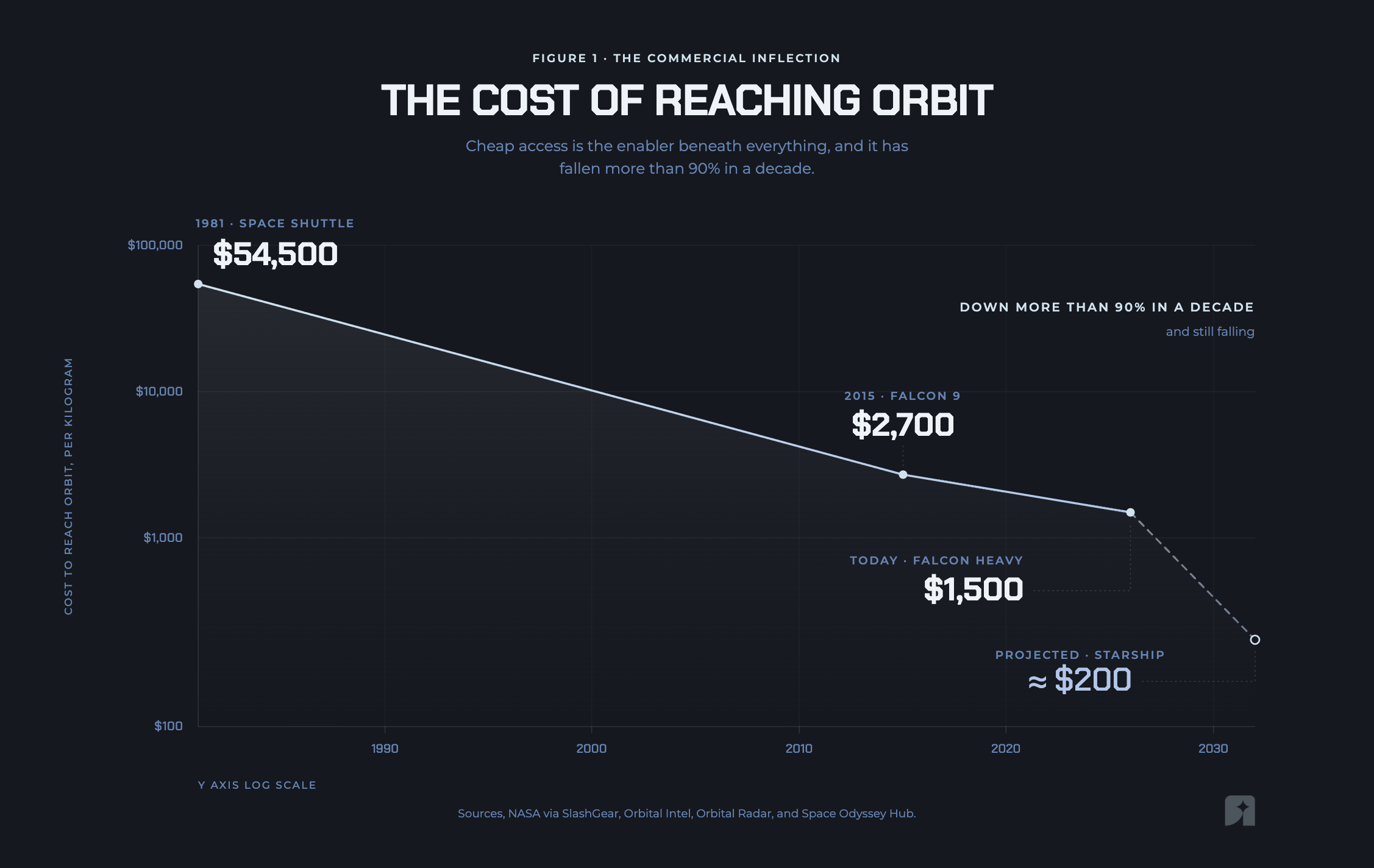
Falling launch cost is the enabler. The pull is the terrestrial bottlenecks from earlier, power, heat, and time binding at once, and the proof feasibility crossed a line is Starcloud-1, which ran an H100 in orbit in November 2025 and did real work.57
Space is cheaper to reach, needed more than ever, and now proven to work. All three point to now rather than later, but none says the economics add up.
Business Model and Unit Economics
A business is a model for making money and a claim that the money works, and for Starcloud the first is clear while the second is the entire debate.
Revenue
What Starcloud sells is simple to state, orbital GPU capacity rented as a cloud service.
The product is compute sold by the unit, GPU time rented the way any cloud rents it, priced on the premise that the satellite carries its own power and cooling and pays nothing for land or grid.
The model has three layers, ordered by how soon each can earn.
Nearest is processing data already in orbit, where an Earth observation operator pays to compute on its imagery in space rather than downlink it first. Behind that sits defense and government demand for compute off the grid.
Furthest out, and by far the largest, is general AI training and inference sold against terrestrial cloud, the layer that only opens if the cost math closes.
Only the first layer is close to earning, and not before 2027.
A clear model with no revenue is not unusual for hardware this early. What decides it is whether each unit of compute sells for more than it costs to produce.
Cost
Here is the part every headline skips. Compute in orbit costs several times what it does on the ground today, a verdict three models reach by different routes.
McCalip's open model puts a 1 GW orbital build at roughly $51B over five years against $16B terrestrial. The gap widens from 3x to 4x over a decade because the constellation is disposable and must be replaced entirely, while a ground site is repaired in place.5859
SemiAnalysis builds the stack from first principles and lands higher, more than 4x, roughly $8.64 against $2.37 per GPU-hour for a comparable cluster.6061
Google’s Project Suncatcher frames it per kilowatt, about $14,700 a year in orbit against $570 to $3,000 on the ground.
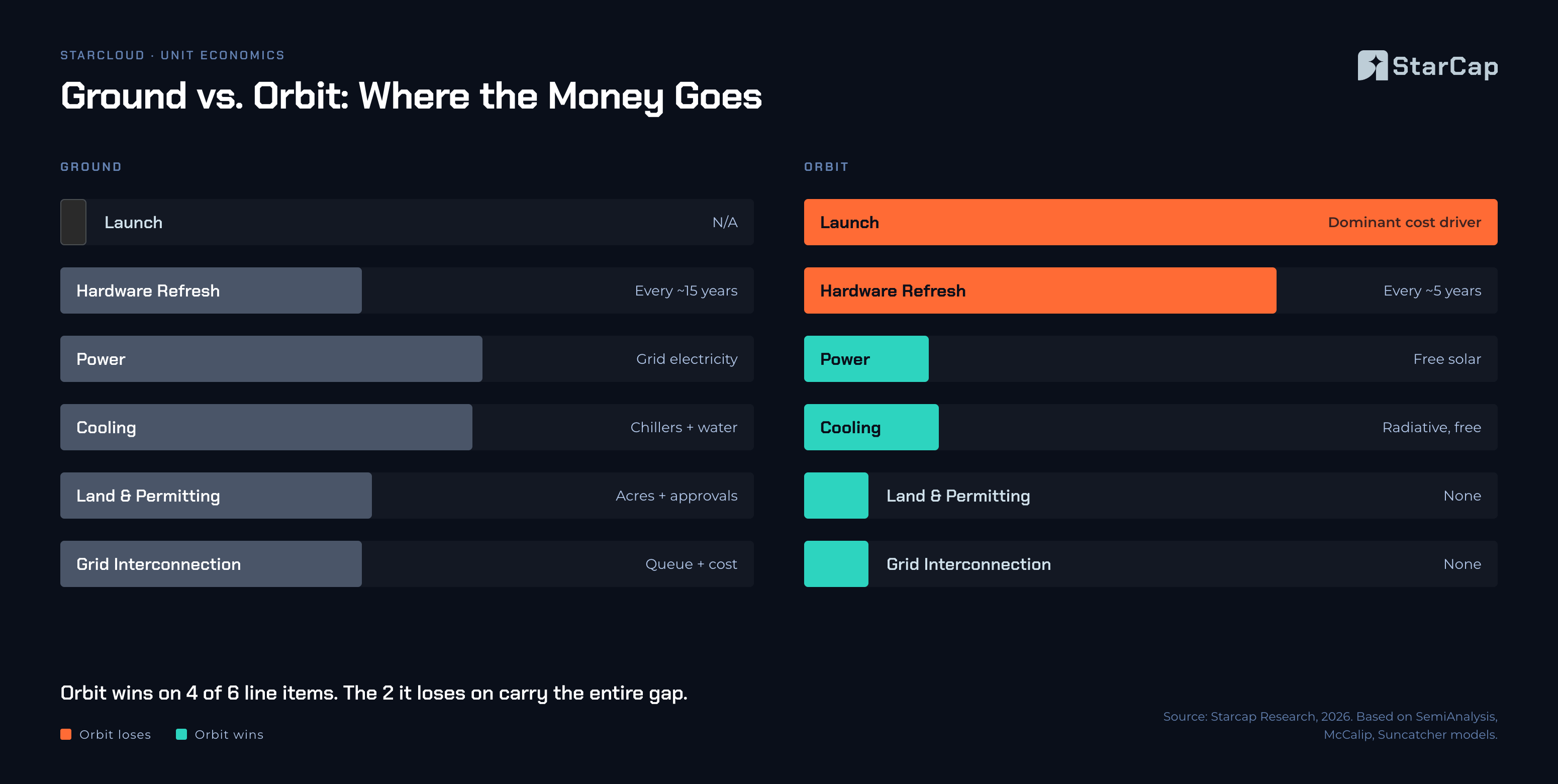
The gap comes from the cost of launching mass, building satellites at around $1,000 per kg, and a five-year orbital life against fifteen years on the ground.62 And radiation shielding is under 2% of mass, barely a factor.
This is why orbital compute is best read per watt of usable power, not per chip. The watt is the bottleneck.
Starcloud has not disclosed a first-principles cost per GPU-hour, and its published claims, a 40 MW cluster at $8.2M over ten years and energy near $0.005 per kWh, reconcile with no independent model and sit below what launch alone would cost.63
The whole gap turns on one variable, launch cost. Parity needs roughly $200/kg against $2,700 to $7,000 today, an 18x fall, plus hardware surviving five years and solar above 40% efficiency.
Models put that between 2028 and 2030 for narrow workloads, closer to 2040 in the base case.64 So today the economics don't close, and the whole bet is one number falling far enough.
Valuation
The last question is what price the market has put on that bet.
The March 2026 round set $1.1B and the August extension took it to $2.3B, NVIDIA joining at roughly $25M.
That price is paid against the revenue and costs described, income that is effectively pre-commercial and unit costs three to four times terrestrial.
The diagram below tracks the valuation from $1.1B in March to $2.3B by August 2026, against revenue that is still pre-commercial. At that price a buyer is underwriting a future, not any economics that exist today.
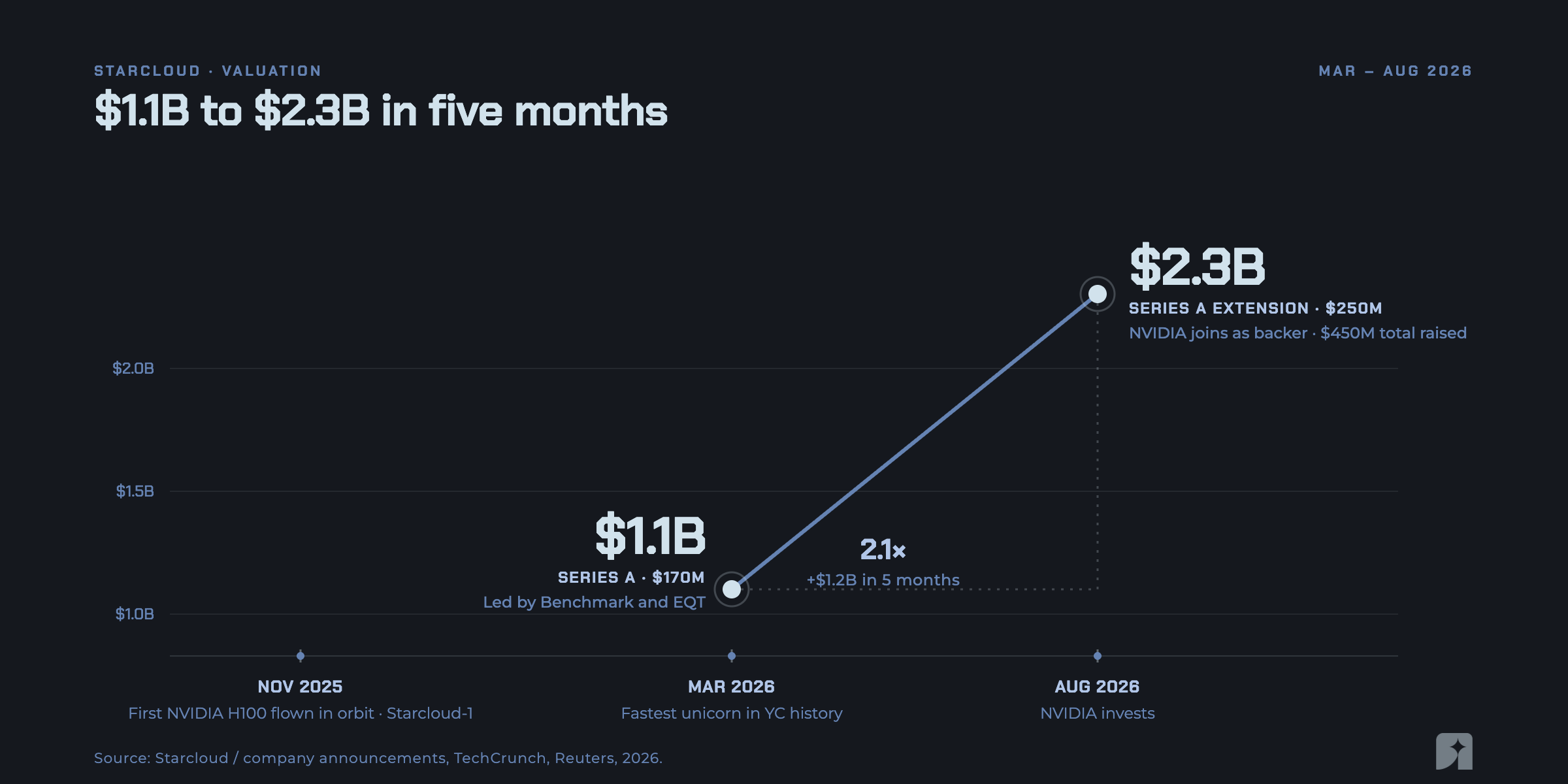
Whether that price is sane depends on beliefs about launch cost and time, which is where the bull and the bear finally part.
A model that only works at a launch cost nobody has reached yet raises the next question, what stops anyone else from doing the same thing the moment it does.
Competition and Moat
If the economics turn on one external variable, the competitive question is not who has the best technology, but who is positioned when that variable moves.
Who Else
The list of who else is building this is longer than the milestones suggest, mostly startups planting flags before Big Tech scales in.65
Starcloud has the strongest claim so far, the only company running a terrestrial-class H100 in orbit and the first to train a model there.
Most rival space chips are built for edge processing, light onboard tasks like compressing images before downlink, not heavy training.
Axiom Space ran an ISS prototype in late 2025 and deployed two computing nodes in January 2026 aboard Kepler Communications, which launched 10 optical relay satellites that month as the mesh backbone others lean on. Lonestar is a different business, lunar data storage for disaster recovery, not AI compute.66
The larger shadows belong to Big Tech. Google's Project Suncatcher plans two prototype satellites with Planet Labs by early 2027,67 Blue Origin has sketched gigawatt-scale facilities, and SpaceX has a filing accepted for up to 1 million satellites, against Starcloud's 88,000.
The competitor that matters today is a ground data center. CoreWeave runs 250,000-plus GPUs across 43 sites, and Crusoe, Starcloud's own launch partner, is also a terrestrial rival with a 20 GW pipeline.68 Orbital compute costs 3 to 4x more today, so the near-term fight is against the ground, not Google.
One name on the list, though, is different in kind.
The Threat
SpaceX owns the variable everyone else is waiting on, which makes it the competitor to take seriously.
The case for SpaceX is close to overwhelming on paper. It controls launch, the single input that decides orbital economics, and can bundle that with satellite manufacturing, the Starlink optical network, and, through its Terafab effort with Tesla and Intel, even chips.
No pure-play startup can assemble that stack. Its own filing names launch as a foundational advantage,69 and its million-satellite plan ties directly to the Starlink network already in orbit.
The approach is also copyable. Orbital compute is commercial GPUs, solar, and radiative cooling, and SpaceX could in principle fit chips into mass-produced Starlink buses. By one biased estimate, it could put about a gigawatt of compute in orbit this way by 2028 to 2029.70
The risk is not only price. It is category capture, SpaceX packaging the full stack before a specialist proves its economics.
Taken at full strength, the SpaceX threat is the strongest argument against every independent player in this field, which is why the moat question has to answer it.
The Moat
If SpaceX can do all that, the question is why an independent orbital compute company should exist, and the answer is not that SpaceX cannot, but that it is busy.
SpaceX is building Mars vehicles, Starlink, xAI, and its own chip supply at once, and orbital compute has to compete for attention and launch slots against all of it. A company doing only this can move faster on only this.
That focus is what makes the rest defensible. Flight heritage and operational data no one else has. The NVIDIA co-development of the Vera Rubin Space-1 chip, built on Starcloud's flight results,71 which is the clearest sign an essential supplier wants an independent door to orbit open.
Add the manufacturing lines going up in Woodinville to build Starcloud-3 at scale, and the plain 18-month lead to orbit, and the moat starts to hold.72
Starcloud must book enormous SpaceX launch capacity as the market tightens, with Falcon 9 winding down by 2028, Starship still unproven, and New Glenn, Vulcan, and Neutron not yet flying regularly. Starcloud-3 is built to ride Starship.
Johnston has said that failing to secure SpaceX capacity toward the end of the decade would be challenging.
A moat is a claim until something proves it. The signals are what prove it.
Traction
The case for Starcloud can be made almost entirely in signals other people have sent, capital committed, contracts signed, and hardware flown.
Capital
Start with the money, because it is the loudest signal and the easiest to verify.
Starcloud has raised about $450M since its founding in January 2024.73 The March 2026 Series A brought in $170M at a $1.1B valuation, led by Benchmark and EQT, making it the fastest unicorn in YC history at 17 months from demo day, in a round more than 2x the next largest YC Series A.7475
Five months later, an August 2026 extension added $250M at a $2.3B valuation, led by Manhattan West, with NVIDIA in for roughly $25M alongside Cisco Investments and returning backers.
The roster matters as much as the sum because NVIDIA supplies the chips and now the capital, Cisco brings the data center infrastructure, and In-Q-Tel, the venture arm of the US intelligence community, on the cap table as a demand signal as much as a funding one.76
Money is the easiest signal to send and the loudest to read, which is why it should be weighed against the two harder to fake.
Customers
Capital is conviction. Contracts sit closer to actual demand, though not yet at revenue.
Start with Crusoe. In October 2025 it agreed to run Crusoe Cloud on a Starcloud satellite and sell limited GPU capacity from orbit by early 2027, the first public cloud in space, though the deal's scale is undisclosed.77
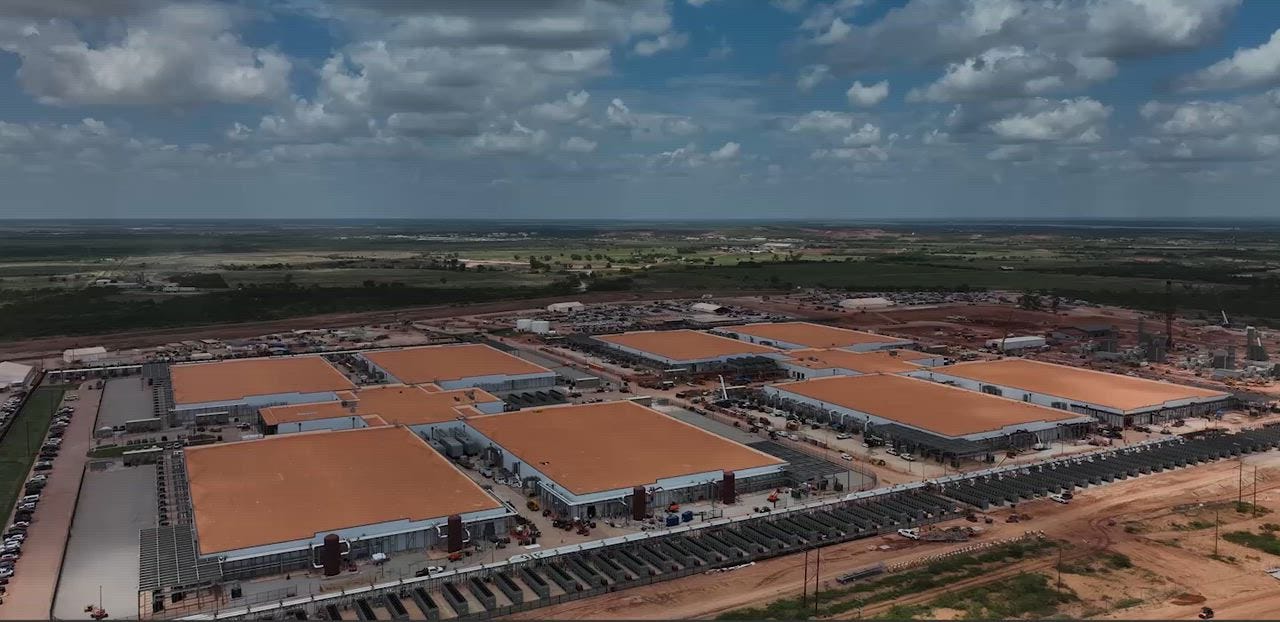
Starcloud is also working with NVIDIA on the Space-1 Vera Rubin module and has signed SpaceX to fit its satellites with Starlink laser terminals, 50-plus units across 25-plus satellites at up to 25 Gbps, with first hardware on orbit within a year.
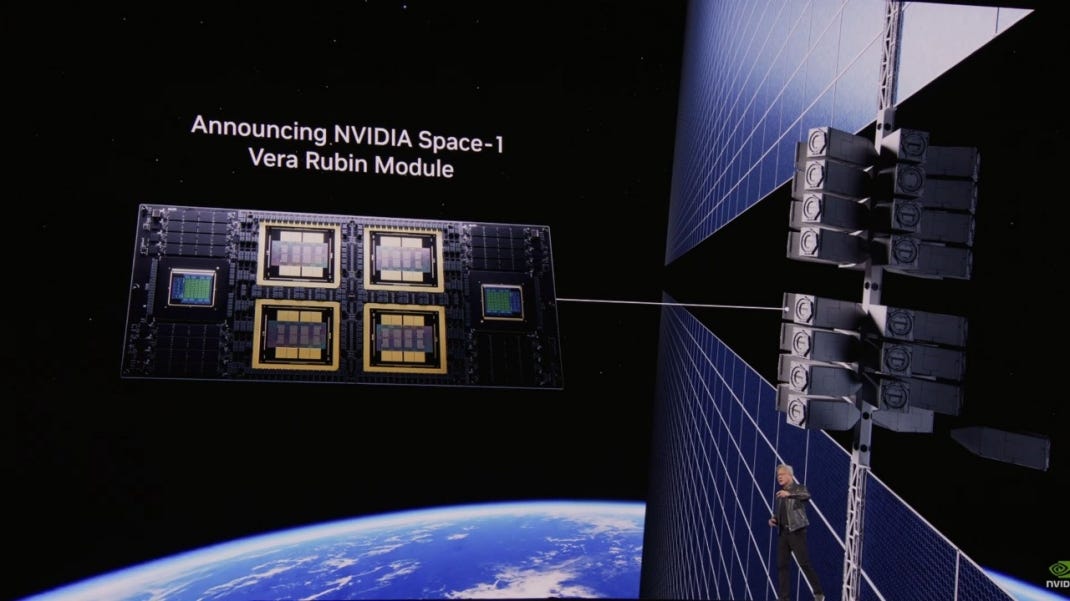
What unites these is that every one is forward-dated. They are commitments to buy or to build, not yet income, and the largest of them does not switch on until 2027.
Signed intent is a real signal and a fragile one, since the whole of it still depends on hardware performing in orbit at a scale no one has reached.
Proof
The last signal is the hardest to fake, hardware that has actually flown.
In November 2025 Starcloud-1 carried the first Nvidia H100 into orbit, a roughly 60 kg satellite at 325 km with an 11-month operating life, and in December it ran what the company reported as the first large language model trained in space.
The next step is a purpose-built space chip that does not yet exist, which the company hopes to fly in late 2028, with production lines going into a 100,000-square-foot facility in Woodinville, Washington, and a team still in the low tens.
One flown H100 proves that a GPU can survive launch, radiation, and vacuum and do useful work. It does not prove that thousands of them can, profitably, for five years, which is the distance between this milestone and the business.
Every one of these signals is real, and not one of them is revenue, which is where the honest case against the company begins.
The Case Against
Everything above is true, and here is why it might not matter.
The Gap May Never Close
The entire thesis rests on one number moving in one direction by enough. Orbital compute costs 3 to 4x what it does on the ground, and parity needs launch cost to fall roughly 18x, from $2,700-$7,000/kg to around $200, plus hardware surviving five years in orbit and solar above 40% efficiency.
Independent models put that crossover somewhere between 2028 and 2030 for narrow workloads and closer to 2040 in the base case. That is a twelve-year window of uncertainty around the one variable the whole industry is waiting on.
If Starship never hits the cost targets its proponents assume, or hits them five years late, the economics never close and the model falls apart.
Even if the economics work, a business needs a market, and this one may be thinner than it looks.
The Market May Be Too Small
Orbit cannot serve every workload. Real-time trading, gaming, and video are ruled out by latency. Training at scale is constrained by inter-satellite bandwidth that cannot yet match terrestrial clusters.
What remains is batch inference, post-training, simulation, and data already in space.
That is a real market, but a fraction of the multi-trillion dollar AI infrastructure pool that justifies the ambition.
The dream TAM, $5.2T in AI data center capital by 2030, assumes orbital compute eventually competes with the ground for general workloads.
If latency and bandwidth confine it permanently to batch and space-native layers, the serviceable market may never grow past single-digit billions.
A business can be built there, but a $2.3B valuation is hard to justify on it. Then there is SpaceX.
SpaceX
The strongest version of this threat is not competitive. It is existential.
SpaceX controls launch, the one input that decides orbital economics, and can bundle it with satellite manufacturing, the Starlink optical network, and its own chip supply through Terafab.
It has a filing for up to 1 million satellites, and by one estimate could loft a gigawatt of compute by 2028 to 2029 on mass-produced Starlink buses.
If SpaceX decides orbital compute is worth doing, it does not need to outbuild Starcloud. It needs to announce. The capital and customer attention that sustains an independent pure-play can evaporate on a press release.
Even with SpaceX held off, the hardware itself is a problem that never stops.
The Hardware Treadmill
A satellite lasts roughly five years in orbit. A ground data center lasts fifteen. That means the constellation is not built once. It is rebuilt continuously.
Every five years the hardware full stack, GPUs, solar arrays, radiators, bus, must be manufactured, launched, and deployed again.
A terrestrial operator replaces chips and cooling units in a building that stays. An orbital operator replaces everything, including the building.
This is the structural reason the 3x cost gap widens to 4x over a decade in every independent model. It does not improve with scale. It compounds.
SpaceX may never build an orbital data center at all, and still decide the outcome, since everyone else has to ride its one rocket.
One Rocket
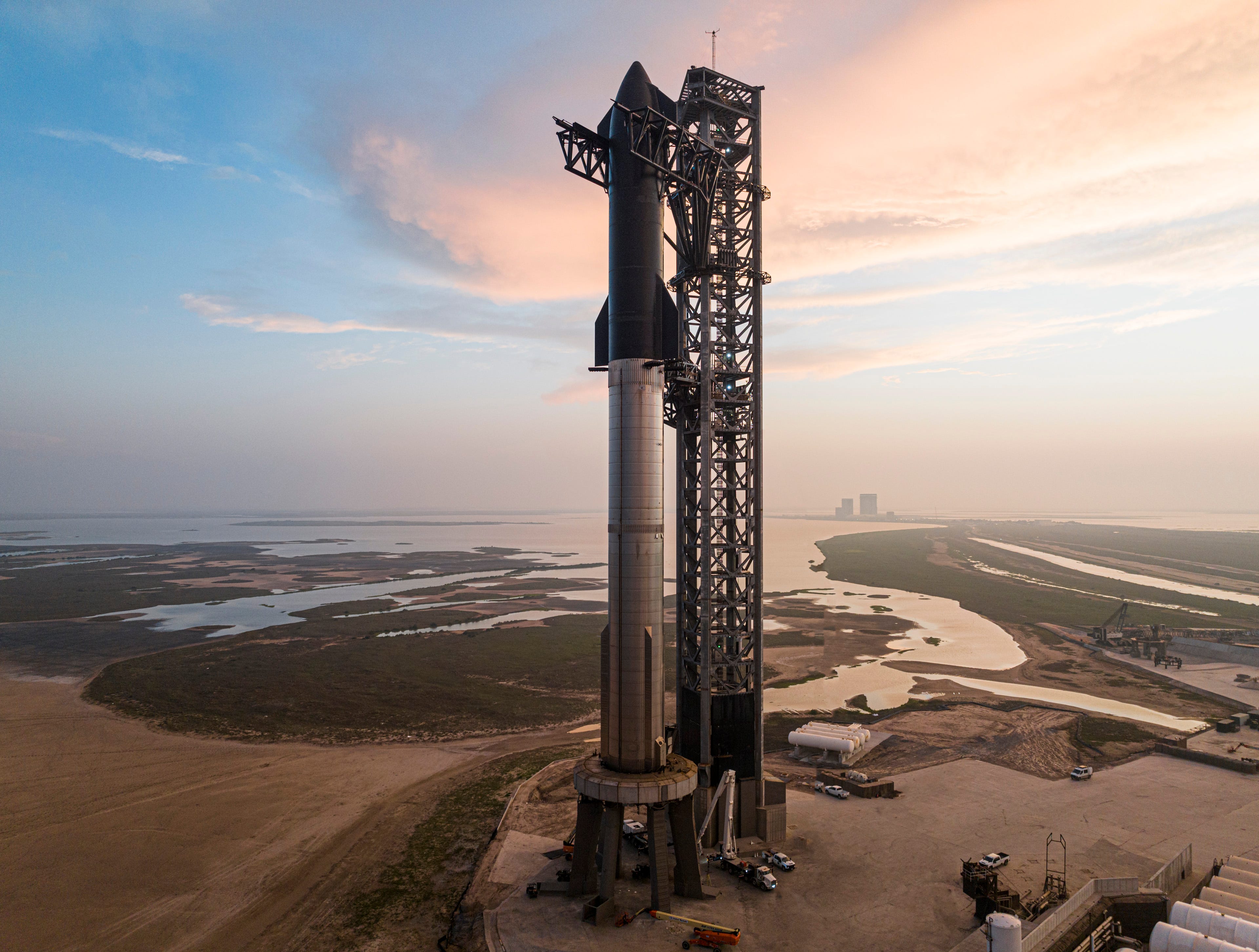
Starcloud-3, the vehicle the economics depend on, is designed for Starship, which is not yet flying commercial payloads reliably.
Falcon 9 winds down by 2028, and New Glenn, Vulcan, and Neutron are not yet flying regularly, leaving Starship as the only way this works.
Philip has said that failing to secure SpaceX capacity toward the end of the decade would be challenging. The latest $250M raise lists launch allocation as an explicit use of funds.
A company whose existence depends on a competitor’s rocket reaching a cost target that competitor has not yet demonstrated is carrying a risk no amount of capital alone resolves.
Stack these risks together, and the question becomes what you are paying to take them on.
The Price of the Bet
All of this sits behind a $2.3B valuation. The March round set $1.1B. Five months later, with no new revenue, the extension doubled it.
At that price a buyer is not paying for what exists but underwriting a future where launch costs fall 18x, hardware survives orbit, the addressable market expands beyond batch workloads, and SpaceX either doesn't enter or doesn't win.
That is the case against at full strength, and if any of these conditions break, there is no revenue base beneath the valuation to cushion the fall.
The last question is what would have to come true, and by when, to prove it wrong.
What Has to Be True
The case against named the ways Starcloud fails. This scorecard names the nine things that have to go right for it to work. Check back on each.
Launch cost: Starship sustains roughly $200/kg to orbit before 2030.
Starcloud-2: The pair of 8 kW satellites launching in 2027 run orbital inference at promised capacity and handle 100x the heat load of Starcloud-1.
Launch allocation: Starship slots contracted before Falcon 9 winds down in 2028.
The NVIDIA chip: Vera Rubin Space-1 ships on schedule and flies on Starcloud-3.
Revenue: Paying customers before the next raise.
Market expansion: Capabilities grow beyond batch inference and space-native data by end of decade.
Starcloud has moved faster than any company in this field, and speed is the one thing the team has proven. The rest is execution against the clock.
This piece also appears on our LinkedIn and X. Thanks for reading. Follow us for more, or reach out at afan[at]starcap[dot]xyz.
Sources
https://techcrunch.com/2026/08/21/starcloud-raises-200-million-for-orbital-data-centers-as-launch-options-dry-up/
https://www.businesswire.com/news/home/20260821884035/en/
https://www.iea.org/reports/energy-and-ai/energy-demand-from-ai
https://www.scientificamerican.com/article/ai-will-drive-doubling-of-data-center-energy-demand-by-2030/
https://www.energy.gov/articles/doe-releases-new-report-evaluating-increase-electricity-demand-data-centers
https://eta.lbl.gov/publications/2024-lbnl-data-center-energy-usage-report
https://www.downtoearth.org.in/energy/energy-demand-for-data-centres-to-double-by-2030-ai-biggest-driver-iea
https://ieefa.org/resources/projected-data-center-growth-spurs-pjm-capacity-prices-factor-10
https://insidelines.pjm.com/pjm-auction-procures-134311-mw-of-generation-resources-supply-responds-to-price-signal/
https://www.utilitydive.com/news/pjm-interconnection-capacity-auction-data-center/808264/
https://whopaysfordatacenters.com/capacity-auctions/
https://www.moduledge.com/blog/nvidia-blackwell
https://blog.se.com/datacenter/2025/07/23/ai-data-center-design-and-deployment-are-moving-at-an-incredible-pace-3-ways-to-approach-a-changing-landscape/
https://dcatlas.io/en/articles/technical/100kw-rack-era-ai-power-cooling
https://intuitionlabs.ai/articles/nvidia-hgx-data-center-requirements
https://newsletter.semianalysis.com/p/gb200-hardware-architecture-and-component
https://mostpolicyinitiative.org/science-note/data-center-water-use/
https://www.eesi.org/articles/view/data-centers-and-water-consumption
https://emp.lbl.gov/publications/queued-2025-edition-characteristics
https://www.publicpower.org/periodical/article/report-details-projects-looking-interconnect-grid-end-2024
https://emp.lbl.gov/publications/queued-2024-edition-characteristics
https://www.rabobank.com/knowledge/d011524694-the-sprint-data-centers-are-building-a-parallel-energy-system-in-the-us
https://www.paradoxintelligence.com/themes/gas-turbine-manufacturing-bottleneck-power-ai-demand
https://earth.gsfc.nasa.gov/climate/projects/solar-irradiance/science
https://arxiv.org/pdf/2512.09044
https://research.33fg.com/analysis/where-should-space-data-centers-live-the-solar-radiation-and-capacity-benchmarking
https://starbench.substack.com/p/an-early-guide-to-orbital-data-centers
https://blogs.nvidia.com/blog/starcloud/
https://spectrum.ieee.org/orbital-data-centers-heat
https://blacknightspacelabs.com/blog/starcloud-nvidia-h100-orbit-first-ai-training-space
https://www.datacenterfrontier.com/site-selection/article/55337494/starcloud-launches-orbital-ai-data-center-with-nvidia-h100-gpu
https://www.cnbc.com/2025/12/10/nvidia-backed-starcloud-trains-first-ai-model-in-space-orbital-data-centers.html
https://www.datacenterdynamics.com/en/news/starcloud-1-satellite-reaches-space-with-nvidia-h100-gpu-now-operating-in-orbit/
https://space.skyrocket.de/doc_sdat/starcloud-1.htm
https://scienceblog.com/t-starcloud-first-llm-trained-orbit-nvidia-h100-500-km/
https://www.ycombinator.com/companies/starcloud
https://spacenews.com/starcloud-files-plans-for-88000-satellite-constellation/
https://www.geekwire.com/2025/starcloud-power-training-ai-space/
https://blacknightspacelabs .com/blog/orbital-data-centers-explained-why-move-computing-to-space-thermal-solar-energy-latency
https://www.adlittle.com/en/insights/viewpoints/data-centers-go-orbital
https://www.forethought.org/research/will-we-really-put-data-centers-in-space
https://www.datacenterdynamics.com/en/news/lumen-orbit-rebrands-to-starcloud-raises-another-10m-for-in-orbit-data-centers/
https://en.wikipedia.org/wiki/Starcloud
https://ideas.everywhere.vc/p/starcloud-philip-johnston-founders-everywhere
https://www.geekwire.com/2025/lumen-orbit-starcloud-10m-space-data-centers/
https://time.news/starcloud-founders-plan-80000-year-interstellar-mission-to-alpha-centauri/
https://www.starcloud.com/team
https://www.mckinsey.com/featured-insights/themes/the-space-economy-is-projected-to-reach-1-8-trillion-by-2035
https://www.weforum.org/press/2024/04/space-economy-set-to-triple-to-1-8-trillion-by-2035-new-research-reveals/
https://www.weforum.org/publications/space-the-1-8-trillion-opportunity-for-global-economic-growth/
https://www.mckinsey.com/industries/technology-media-and-telecommunications/our-insights/the-cost-of-compute-a-7-trillion-dollar-race-to-scale-data-centers
https://www.grandviewresearch.com/industry-analysis/earth-observation-market-report
https://www.marketsandmarkets.com/PressReleases/geospatial-imagery-analytics.asp
https://orbitalradar.com/space-economy/launch-cost-trends
https://newspaceeconomy.ca/2026/08/22/how-fast-are-space-launch-costs-falling/
https://orbitalradar.com/glossary/launch-cost
https://www.datacenterdynamics.com/en/news/crusoe-to-deploy-in-starcloud-satellite-data-center-in-late-2026-offer-limited-gpu-capacity-in-space-from-2027/
https://spaceedu.org/journal/orbital-data-centers/
https://www.techtarget.com/ai/feature/When-orbital-AI-data-centers-become-business-reality
https://newsletter.semianalysis.com/p/to-boldly-go-the-case-for-space-datacenters
https://www.useluminix.com/reports/industry-analysis/data-centers-in-space
https://www.mexc.com/tr-CT/news/691925
https://introl.com/blog/orbital-data-centers-space-computing-race-2026
https://www.datacenterdynamics.com/en/news/project-suncatcher-google-to-launch-tpus-into-orbit-with-planet-labs-envisions-1km-arrays-of-81-satellite-compute-clusters/
https://qz.com/orbital-data-center-startups-competitive-landscape-061526
https://www.fierce-network.com/cloud/space-data-centers-starcloud-spacex-and-project-suncatcher-explained
https://www.networkworld.com/article/4144330/whos-in-the-data-center-space-race.html
https://sacra.com/c/starcloud/
https://www.sec.gov/Archives/edgar/data/0001181412/000162828026040364/spaceexplorationtechnologib.htm
https://digitalhabitats.global/blogs/singularity-navigator/exlumina-founder-spacex-already-controls-the-future-of-space-ai
https://bitcoinworld.co.in/starcloud-raises-250m-orbital-data-centers/
https://bullsource.com/technology/starcloud-raises-250m-for-orbital-data-centers-with-nvidias-help/
https://finance.yahoo.com/technology/ai/articles/starcloud-raises-250-million-2-140000211.html
https://www.businesswire.com/news/home/20260330024111/en/
https://www.geekwire.com/2026/orbital-ai-seattle-area-startup-starcloud-hits-1-1b-valuation-to-build-space-based-data-centers/
https://www.datacenterdynamics.com/en/news/space-data-center-company-starcloud-secures-170-million-series-a/
https://www.crusoe.ai/resources/newsroom/crusoe-to-become-first-cloud-operator-in-space-through-partnership-with-starcloud